New 2026 research, The State of Workplace Resilience.
Download →
RESILIENCEBUILDER Book a call
UK resilience development practice

Resilience: the key to sustaining performance under pressure and change.

Data-driven resilience assessment with targeted training for individuals, leaders, and teams. We identify the root causes of stress and build resilience to reduce burnout, increase engagement and wellbeing, and sustain high performance.

Founded by Steve Howe · UK HQ, delivered worldwide · Coventry University MBA
9x
More likely to perform at an optimal level
ResilienceBuilder Research 2024
12x
Less likely to experience burnout
ResilienceBuilder Research 2024
£5:£1
ROI on workplace wellbeing
Deloitte Mental Health and Employers 2022
20%
Global employee engagement, an all-time low
Gallup State of the Global Workplace 2025
Selected clients and coaches

Trusted by organisations from SME to FTSE 250, in the UK and overseas.

Financial services, healthcare, professional services, public sector, technology, automotive. Named clients on request under NDA.

[PLACEHOLDER client 1]
[PLACEHOLDER client 2]
[PLACEHOLDER client 3]
[PLACEHOLDER client 4]
[PLACEHOLDER client 5]
[PLACEHOLDER client 6]
[PLACEHOLDER client 1]
[PLACEHOLDER client 2]
[PLACEHOLDER client 3]
[PLACEHOLDER client 4]
[PLACEHOLDER client 5]
[PLACEHOLDER client 6]
“ResilienceBuilder helped us identify individual and team challenges, and equipped us with practical tools to address them. It’s had a positive impact on the way we work together, especially in a fast-paced, high-pressure environment. I’d highly recommend it to other leaders and teams.”
Chris-Markus Kratz · Director · AWS Automotive
[PLACEHOLDER] “The assessment gave us the first honest conversation about resilience we’ve ever had at board level. The data makes it impossible to ignore.”
[PLACEHOLDER] · HR Director · [PLACEHOLDER: Financial services]
[PLACEHOLDER] “Becoming a certified ResilienceBuilder coach gave me something my clients couldn’t get anywhere else, a validated tool and a pedagogy that holds.”
[PLACEHOLDER] · Independent Coach · [PLACEHOLDER]
What is resilience?

The protective factor that keeps people performing when pressure rises.

Resilience is a set of trainable habits, not a personality trait or a mood. It is what stops stress becoming illness, what keeps teams performing through change, and what makes sustained effort possible when the reward is slow to arrive.

We measure it across five validated facets, all underpinned by the Science of Resilience:

  • Mental Strength. Cognitive habits that keep people clear, focused and decisive when pressure rises.
  • Purpose & Motivation. The why behind the work. People with a clear sense of purpose recover faster.
  • Physical Stamina. Sleep, recovery and energy management. The foundation most programmes skip.
  • Emotional Intelligence. Self-awareness and empathy under load. How teams behave when things go wrong.
  • Social Support. The quality of working relationships. The single biggest predictor of recovery.
How do we do it?

Measure. Build. Sustain.

A three-phase protocol designed so the outcome outlasts the engagement. Every client follows the same shape, the detail is shaped by what the data shows.

01
Measure

A validated 15-minute psychometric scores each person across the five facets. Individual report, team dashboard.

02
Build

Workshops, training and 1:1 coaching, sequenced by the data. Not a generic curriculum.

03
Sustain

Ongoing self-learning materials so it holds after we leave. Re-measurement on request.

Your options

Three ways to work with us.

Ways we work

Eight ways we work with you.

Every engagement starts with the same assessment. What changes is the audience and the format, shaped by the data your team gives us. Coach certification lets you deliver the whole model inside your own practice or L&D team.

The science behind the model

Five factors that underpin sustained performance.

The ResilienceBuilder Model sits on top of four decades of published research into stress, adaptation and sustained performance. The Science of Resilience is not a sixth facet. It is the frame that holds the five facets together, and the reason the assessment is measurable, repeatable, and credible at board level.

The model

Five facets of resilience.

Each facet is independently scored, individually coachable, and tracked over time. Together they map the skills that sustain performance under pressure and change.
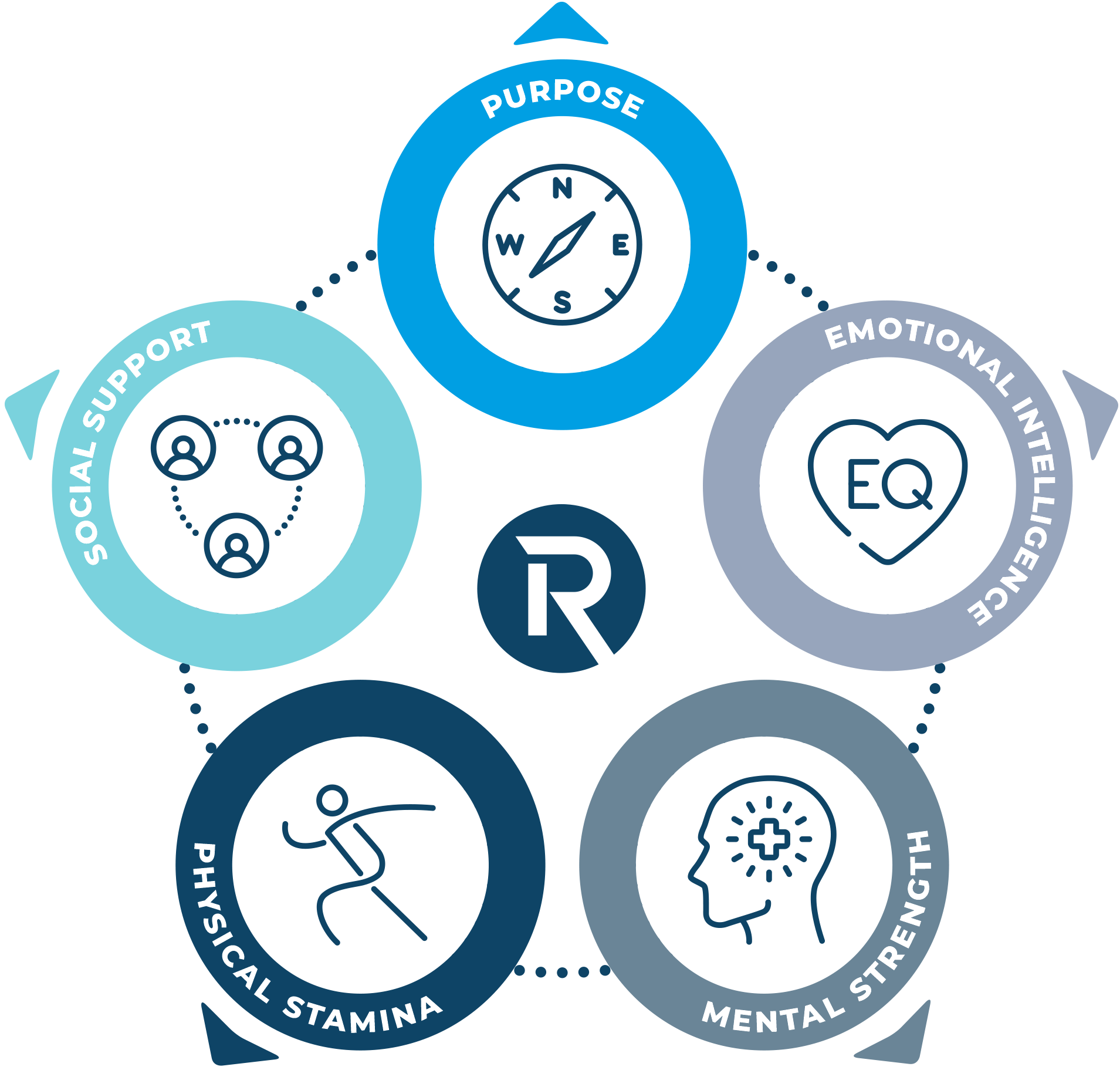
The ResilienceBuilder Model: five facets surrounding the Science of Resilience core
  • 01

    Mental Strength

    Cognitive habits that keep people clear, focused and decisive when pressure rises.

  • 02

    Purpose & Motivation

    The why behind the work. People with a clear sense of purpose recover faster.

  • 03

    Physical Stamina

    Sleep, recovery and energy management. The foundation most programmes skip.

  • 04

    Emotional Intelligence

    Self-awareness and empathy under load. How teams behave when things go wrong.

  • 05

    Social Support

    The quality of working relationships. The single biggest predictor of recovery.

Five facets One validated assessment Tracked over time
What the evidence shows

Published research on what resilience moves.

Published research links higher measured resilience to lower stress-related absence, reduced attrition, stronger performance under pressure and better engagement. We lead with the evidence base, and with what we have learned about the characteristics of resilient people, rather than with headline client statistics while our own longitudinal dataset is still being built.

Absence
Up to 40%

Reduction in stress-related absence after structured resilience training.

[source: meta-analysis of workplace resilience interventions, peer-reviewed]
Attrition
Significant

Measurable reduction in voluntary attrition in cohorts with higher measured resilience.

[source: longitudinal workforce study, placeholder]
Performance
Higher

Sustained performance under pressure correlates with scores in Mental Strength and Physical Stamina.

[source: ResilienceBuilder cohort data, 2023 to 2026]
Engagement
20%

Global employee engagement at an all-time low in 2025. Resilience is the protective factor.

Gallup State of the Global Workplace, 2025
Our insights

The characteristics of resilient people.

Patterns we see across more than two thousand individuals assessed on the ResilienceBuilder Model. These are habits, not personality traits. Every one of them is trainable.

01

They name what they feel

Resilient people do not suppress stress. They notice it, label it, and respond to it deliberately.

02

They recover on purpose

Recovery is not an accident. Sleep, exercise, and genuine downtime are treated as performance inputs, not optional extras.

03

They have reasons bigger than themselves

A clear sense of purpose predicts who stays in difficult work and who walks away from it.

04

They ask for help early

The single biggest predictor of recovery is the quality of working relationships. Resilient people build those before they need them.

05

They learn from what went wrong

Not self-criticism. Calm, specific review. What happened, what I did, what I would do differently.

06

They keep going when results are slow

Resilience is not a feeling. It is the habit of continuing to act sensibly when immediate feedback is missing.

The question every HR director is asking

How do I measure resilience in my workforce?

Use a validated psychometric to measure resilience across five facets, mental strength, purpose and motivation, physical stamina, emotional intelligence and social support, underpinned by the Science of Resilience. Measure before any intervention, build what the data says is weakest, then sustain it with ongoing materials and re-measurement.

ResilienceBuilder is a resilience development practice founded by Steve Howe. Every engagement begins with the ResilienceBuilder Assessment, a validated psychometric taught at postgraduate level on the Coventry University MBA and delivered to organisations globally.

This is sometimes called workforce resilience, workplace resilience, or resilience development. What it is not: a wellbeing survey, a mood tracker, or a generic training workshop. It is measurement first, the data tells us what to build.

Individuals own their personal data. Organisations receive aggregate, board-ready reporting. The assessment is repeatable, comparable, and designed to track and sustain outcomes over time, not to describe feelings.

Take the free 5-minute assessment →

Three ways in

Where do you fit?

Insights

All writing →
Quick answers

The short version.

What is the ResilienceBuilder Assessment?

A 15-minute online psychometric that measures resilience across five facets, underpinned by the Science of Resilience. It produces an individual report for each person and an anonymised aggregate dashboard for the organisation.

How is it different from a wellbeing survey?

A wellbeing survey reports how people feel. The ResilienceBuilder Assessment measures resilience as a skill, across five independent facets, and is designed to be re-measured so change can be tracked and sustained.

How long does a programme take?

The assessment itself takes 10 to 15 minutes. A typical organisational programme runs 90 to 180 days from assessment to intervention to re-measurement, followed by ongoing self-learning materials.

Where is it delivered?

ResilienceBuilder Ltd is registered in England and Wales and works with organisations in the UK and overseas. The assessment is delivered in English and taught on the Coventry University MBA.

Who owns the individual assessment data?

The individual. Every person who takes the assessment owns their personal report. Organisations only receive anonymised aggregate reporting at team or cohort level.

Can we roll it out across a workforce?

Yes. Company-wide programmes are multi-site, multi-cohort, and assessment-led. Aggregate dashboards for HR, personal reports for individuals, and the option of targeted training and coaching informed by the data.

How does this help HR or L&D justify the investment?

The assessment produces comparable, repeatable data across cohorts and over time. That lets HR and L&D teams take a measurable baseline to the board, target interventions where the data shows weakness, and demonstrate direction of travel at 90 and 180 days.

Is there a coach certification?

Yes. Coaches, L&D leads and HR professionals can certify to deliver the ResilienceBuilder Assessment and teach the five-facet model in their own practice or workplace. The certification is CPD recognised.

Next step

Book a discovery call.

Forty-five minutes with Steve Howe. Walk-through of the model, a sample report, and a plan for rolling the assessment into your business.

Free download
The State of Workplace Wellbeing in 2025
Trust, Legal and Governance

ResilienceBuilder is a UK assessment-led resilience development practice. The ResilienceBuilder Assessment, associated training, coaching, and coach certification are delivered by ResilienceBuilder Ltd.

Legal and Registration

Registered in England and Wales. Company number [PLACEHOLDER]. ICO registered [PLACEHOLDER]. Details publicly available via Companies House.

Standards and Data

Operates under UK GDPR and the Data Protection Act 2018. Individual assessment data is owned by the individual; organisations receive anonymised, aggregate reporting only.

Research and Methodology

The ResilienceBuilder Model is a five-facet framework underpinned by the Science of Resilience. Informed by published research and taught on the Coventry University MBA. Content reviewed quarterly.

Reviewed quarterly. Last reviewed: 14 April 2026.
© 2026 ResilienceBuilder Ltd. Company number [PLACEHOLDER: Companies House no.]. Registered in England and Wales. [PLACEHOLDER: registered address]. Privacy PolicyCookie PolicyTerms of ServiceAccessibilityData Processing